
Full Service Interior Design Process Still Studio 2026
Full-service interior design is a single service that manages a home renovation or furnishing project from the first conversation through to the final styling — covering spatial planning, materials, 3D visuals, sourcing, procurement and installation, all through one studio and one point of contact.
If your weekends are free for showroom visits and you don't mind chasing four different tradespeople by email, a lighter decorating service will cover it. It's a different story if you're running two careers, a renovation, and a family calendar that's already full — where trades and finishes all have to line up with each other, where several rooms (kitchen, hallway, sitting room) are being furnished at once and need to feel like one home, or where you've already tried the DIY version once, ended up with a scratch on the new floor and a sofa that wouldn't fit through the door, and decided once was enough.
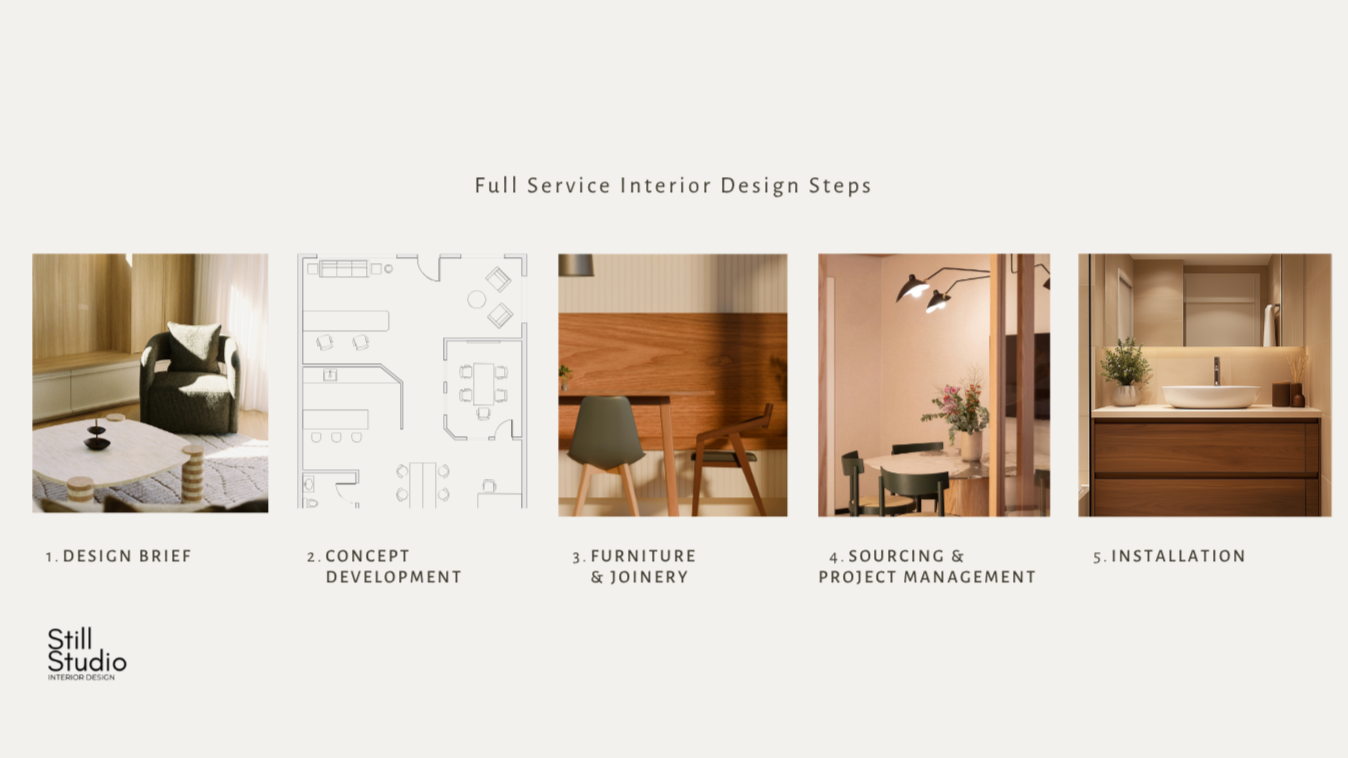
Step One: The Design Brief
Every project starts with listening and understanding how you interact with your home. We meet you at home, or here at the studio, and talk through how you actually live — the school run, the routines that repeat every week, the corner of the house you've learned to work around. We partner with people who see their home as something worth investing in for the years ahead: busy families, people who've renovated once already and want it done properly this time, and the occasional developer who understands that thoughtful design is what actually makes a home sell.
This is also where we talk about where your budget does the most good. Some rooms carry more weight than others — a hallway that sets the tone for the whole house, joinery in a room you'll use every single day. Knowing where to spend, and where to hold back, is most of the job. Spread a budget too thinly across every room and nothing feels finished; put it where it matters and the whole house lifts.
Before anything is chosen, we look at the bones of the house: the floor plan, how the rooms connect, what's structural and what isn't. We work through this with you and with any other professionals on the project, checking early that changes will meet Irish Building Regulations, so nothing needs correcting, expensively, later. A good brief is half creative thinking and half practical planning — the point where what you want starts turning into what's actually possible.
Step Two: Concept Development
Once the brief is set, the character of the home starts to take shape. Mood boards, visuals, material palettes — not just how a room will look, but how it will feel to stand in it.
This means understanding the house itself: when it was built, what's around it, what the architecture is already trying to say. Those things shape the layout and the colours as much as your own taste does. Together, we choose every finish, down to the grain of the floorboards and the grout in the bathroom. We can certainly provide recommendations for harder wearing materials that will patina beautifully with family life, but we also want to make sure that your home feels like your home, with any touches that you have dreamed of since you bought the house.
By the end of this stage, what started as a folder of saved images becomes a plan someone can actually build from, matched to the practical realities of your rooms.
Step Three: Furniture & Joinery
This is where the difference between styling a home and designing one becomes clear. A decorator sources what already exists. A full-service studio makes what the room actually needs. Done well, every piece looks like it was always meant to be there, which is never an accident.
Commissioned pieces and bespoke joinery matter for two reasons. First, proportion: a shop sofa is rarely the right depth for a bay window, or the right scale for a bigger room. Made-to-fit pieces keep a space in balance. Second, what's inside matters as much as what you see — the frame, the springs, the filling. That's what decides whether a sofa lasts fifteen years or five.
We're also glad to work heirloom pieces into a new design: a table that's been in the family for decades, sitting comfortably alongside something made new for the room.
Step Four: Sourcing & Project Management
This is where a full-service studio earns its keep, mostly in ways you never see. We liaise with suppliers, track deliveries, and manage trades on-site so you're not doing it around a full-time job.
Things go wrong on most renovations — a delay, a fabric that doesn't match the sample, a compliance detail on a piece of upholstery. When they do, we handle it: rescheduling trades to protect the timeline, sorting a mismatched delivery before it reaches your home, working through fire-safety certification on commissioned pieces so you don't have to learn the regulations yourself.
This is usually the stage people are glad they didn't try to run themselves. Not because it can't be done — because most people don't have the hours to spare.
Step Five: Installation
Everything comes together on a planned schedule. Furniture arrives from storage on the agreed dates, each piece goes exactly where it was meant to, packaging is cleared away, and the room is set up the way it was drawn.
Styling is what separates a finished room from a lived-in one: where the art hangs, how the cushions sit, what catches the light in the evening. It's a lot of small decisions, made with care rather than left to chance.
By the end, the house is ready to actually live in. Beds are made, art is hung at the right height, the lighting is set. It's your home, built around how you use it — not a showroom, just somewhere that finally works.
Why work with a full-service studio
Choosing full-service design means handing over more than the finishes. It means guidance through the whole process, from the first conversation to the last cushion, backed by a way of working we've refined over many projects. A plan that reflects how you actually live, not a template applied to your address. Honest steer on where your budget does the most good, and where it doesn't need to go at all. Furniture and joinery made for your rooms, built to last rather than to be replaced in a few years. And someone else carrying the supply chain, the regulations and the site problems, so you can focus on the parts you'll actually enjoy.
It's not about decorating rooms. It's about building a home that holds you.
Working with Still Studio
Working with us means a studio that pays attention to the details most people never think to ask about.
When you work with Still Studio, you get design that's genuinely personal, built around your life rather than a template. Clear guidance on where to spend and where to hold back, so the budget works as hard as it can. Joinery and furniture made specifically for your rooms, built for comfort that lasts. And a team that handles the supply chain and the site problems quietly, so you're not the one left chasing anyone.
If any of this resonates, that's usually the right moment to talk. Book a Discovery Call — a conversation about your home, at our studio or yours.
Frequently asked questions
What does full-service interior design include?
It includes spatial planning, material specification, 3D visualisation, sourcing and procurement, and project management through to installation and styling — the whole project, start to finish, through one studio.
How is full-service interior design different from decorating?
A decorator generally sources existing pieces and finishes for a room. Full-service interior design covers the structural and spatial decisions too, manages trades and suppliers, and takes the project through to final installation.
How much does full-service interior design cost?
It varies by project scope — a full renovation costs more than furnishing a single room, and fees depend on the studio's structure and the level of procurement involved. Still Studio quotes per project after an initial Discovery Call, once we understand what's needed.
Is full-service interior design worth it?
It tends to be worth it on projects with real complexity — a full renovation, an extension, or several rooms furnished at once — where the time and stress saved outweigh the fee. For a single room with a flexible timeline, a lighter-touch service is often enough.
Who is full-service interior design for?
Busy homeowners renovating or extending, growing families furnishing multiple rooms at once, and anyone who has tried managing a renovation alone and would rather not do it again.